Cord-cutting accelerated through 2025 and into 2026 as the best IPTV services finally caught up with what cable replacement was always supposed to be. The numbers don’t lie: American cable subscriber counts fell faster in 2025 than any previous year, and the trend is accelerating. Below are 18 specific reasons households are making the switch in 2026 — not generalisations, not marketing talking points, but the actual factors driving real decisions in real American households this year.
This article is structured as a numbered list because the reasons compound. Reason 1 alone might not move a household. Reasons 1 through 5 together usually do. By the time you’ve worked through all 18, the case for staying on cable in 2026 has to be a positive argument, not just inertia. For most households, that positive argument doesn’t exist. The financial, technical, and product-quality cases all point one direction.
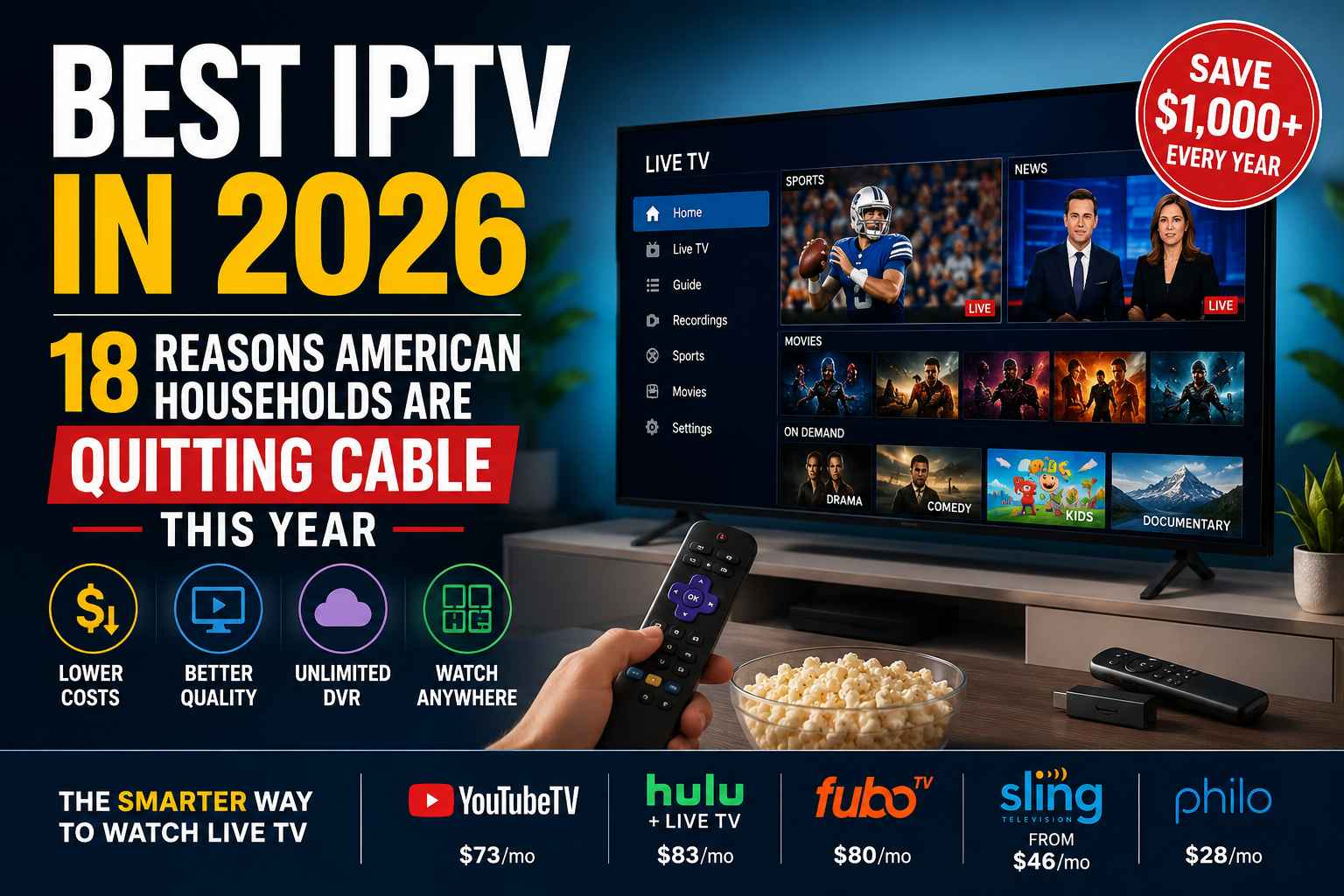
Before the list: the five mainstream best IPTV services this article references are YouTube TV ($73/month), Hulu + Live TV ($83/month), FuboTV ($80/month), Sling TV (from $46/month), and Philo ($28/month). They cover different household profiles and you should choose based on which fits yours, not which has the longest channel list.
Table of Contents
Reason 1 — Your Cable Bill Hit a New High in 2025
Average US cable bills crossed $120 monthly in 2025 and continued climbing into 2026. With sports tier, HD upgrade, DVR fees, and equipment rental, the realistic monthly total for most households reached $150 to $175. Some monopoly-market urban areas with Comcast or Spectrum as the only meaningful broadband-plus-TV options pushed standard packages to $180-$200. Cable retention promotions exist but expire — most households end up paying full standard rates within 12 to 18 months. Against that baseline, every best IPTV service in this guide saves substantial money.
Reason 2 — The Stream Quality Problem Is Solved on the Top Services
Three years ago, IPTV during NFL Sunday primetime was a coin flip. In 2026, YouTube TV, FuboTV, and Hulu + Live TV have invested in CDN infrastructure that handles concurrent peak load reliably. Stream stability during the most demanding live TV streaming windows is now cable-equivalent on these services. The buffering horror stories from 2021-2022 reflect a market that no longer exists for these mainstream best IPTV options.
Reason 3 — The Regional Sports Network Problem Is Mostly Solved
For years, the local team’s RSN was the cable retention reason for sports-first households. FuboTV in 2026 carries more regional sports network coverage across US markets than any competing IPTV service. For most major US markets the answer is now yes — your team is available on streaming. Check the FuboTV channel lookup with your ZIP code to verify before committing.
Reason 4 — EPG Quality Matches Cable Guides
The Electronic Program Guide is the cable-style schedule grid in your player app — channels on one axis, time slots on the other, programme titles in each cell. In TiviMate on a Fire Stick with Xtream Codes login, the EPG renders identically to a cable guide. The best IPTV services maintain accurate daily-updated EPG through Xtream Codes connections. This solves the navigation problem that pushed many early cord-cutters back to cable.
Reason 5 — Player Apps Are Genuinely Polished
TiviMate in 2026 is a polished product, not a side project. IPTV Smarters Pro runs identically across Fire Stick, Roku, iOS, Android TV, and Windows. XCIPTV Player is a genuinely capable free alternative. The player app gap between cable receivers and IPTV apps has closed completely. Long-term cable subscribers switch to TiviMate without an adjustment period.
Reason 6 — Setup Takes Five Minutes
Install TiviMate on a Fire Stick from the Amazon Appstore. Tap Add Playlist. Choose Xtream Codes API. Enter your IPTV provider’s server URL with port number, username, and password. Channels and EPG load within 90 seconds. The whole process from app installation to first channel viewing takes about five minutes per device. There’s no installation appointment, no service technician, no equipment delivery. Compare this to scheduling a cable installation.
Reason 7 — DVR Without Limits
YouTube TV’s unlimited cloud DVR is the feature that converts subscribers permanently. No storage cap, no expiry on recordings, watchable from any device. Cable DVRs typically come with hour limits, scheduled deletion of older recordings, and the requirement to watch from the same physical box. The DVR experience improvement when switching from cable to YouTube TV is real and significant for households that record substantially.
Reason 8 — No Equipment Rental Fees
Cable equipment rental adds $15 to $25 monthly to most bills. IPTV uses devices you already own — Fire Stick, Roku, smart TVs, phones, tablets. No box rental, no remote rental, no installation hardware. Over a year that’s $180 to $300 in equipment rental fees eliminated. Over five years, $900 to $1,500.
Reason 9 — The Bundle Math Favours Streaming Consolidation
Households paying for cable plus Disney+ plus ESPN+ plus Hulu separately accumulate $200+ monthly in TV-related bills. Hulu + Live TV at $83 monthly consolidates four of those into one bill. The math favours consolidation strongly for households already paying for multiple streaming services alongside cable.
Reason 10 — Cancel Anytime, No Contracts
Cable contracts and early termination fees disappear with IPTV. Every mainstream best IPTV service runs month-to-month. Cancel during football season, restart in fall, no penalties. Try a service for one month, decide it’s not for you, cancel before the next billing cycle. The flexibility itself is worth real money compared to the typical cable two-year contract structure.
Reason 11 — Works Across Every Device Your Household Owns
Fire Stick in the living room. Roku in the bedroom. iPhones for everyone. iPad for the kids. Apple TV in the basement. Smart TV in the kitchen. The same IPTV subscription credentials work on every device simultaneously up to the stream limit. Cable boxes worked on the TVs they were physically connected to. IPTV works wherever your household devices go.
Reason 12 — Real Customer Choice in 2026
Five mainstream best IPTV services compete actively. Pricing has stabilised through real market competition rather than monopoly pricing. Feature improvements happen because services need to attract subscribers. The customer-service dynamic with cable monopoly providers — which historically favoured cable companies — has flipped. Streaming services have to earn your subscription monthly.
Reason 13 — Annual Savings That Compound
Switch from $155 cable to YouTube TV at $73 and save $984 in year one. Stay on YouTube TV and save another $984 in year two. Over five years, $4,920 saved. Over ten years, $9,840. The savings don’t require promotional pricing or annual lock-in — just standard monthly prices that hold steady year over year as long as the household stays on the IPTV subscription rather than returning to cable. Meaningful money over the long term.
Reason 14 — The Trial Period Removes the Risk
Every best IPTV service in this guide offers a free trial. Sign up, run the service alongside cable for two to four weeks, use it as your primary TV daily, track when you fall back to cable. The fallback list at the end of the trial tells you whether the switch is ready. For most US households in 2026, the list is short or empty after two weeks. Cancel cable confidently. If the service doesn’t fit your household, you’ve lost nothing. The trial period removes the financial risk entirely.
Reason 15 — Cable Equipment Returns Are Painful, IPTV Has None
Cancelling cable involves returning equipment. The receiver, the remote, the modem if cable provided it. Trip to a UPS store, packaging the boxes, getting a return receipt, hoping cable processes it correctly so they don’t bill you for unreturned equipment. The whole process takes hours of household time. IPTV cancellation involves clicking a cancel button in an account portal. No equipment to return, no UPS trips, no follow-up calls about return processing.
Reason 16 — Mobile Viewing Without Cable’s Streaming App Restrictions
Cable companies historically restricted mobile viewing through their streaming apps — geofencing to your home Wi-Fi, channel restrictions when watching away from home, requirements for periodic re-authentication. The best IPTV services in 2026 work on iPhone, iPad, Android phones, and tablets without these restrictions. Watch the game from a coffee shop. Catch up on a series during a flight. The mobile experience is genuinely portable in ways cable’s mobile experience never quite was.
Reason 17 — Software Updates Without Receiver Reboots
Cable receiver firmware updates were the small but recurring friction point of cable ownership. The receiver decided to update during peak viewing time. The reboot took 20 minutes. Sometimes the receiver wouldn’t come back online and required a service technician visit. IPTV apps update through the app stores like every other application on your devices. No forced reboots during dinner, no service interruptions during sports, no technician visits required.
Reason 18 — The Streaming Age Has Arrived for Mainstream Households
Two years ago, IPTV was for early adopters who were willing to tolerate rough edges in exchange for savings. In 2026, the best IPTV services are mainstream products that most American households can adopt without significant adjustment. The streaming age that cord-cutting advocates predicted for a decade has arrived. Staying on cable in 2026 increasingly requires positive justification rather than just being the inertial default.
Putting It Together
Eighteen reasons compound into a clear conclusion: the best IPTV options in 2026 are genuinely ready for mainstream cable replacement. The financial case is overwhelming. The technical case has been solved. The setup is simple. The trial period removes risk. For American households still on cable in 2026 evaluating whether to switch, the case for staying requires positive justification that most household profiles can’t honestly produce. The decision usually comes down to picking which best IPTV service fits your household — YouTube TV for comprehensive replacement, FuboTV for sports, Hulu + Live TV for bundle value, Sling TV for modular pricing, Philo for entertainment-only budget.
Final Word: Why 2026 Specifically Is the Year to Switch
Each reason above stands on its own, but the timing matters too. Cable bills accelerated their annual increases through 2024 and 2025 as cable providers compensated for shrinking subscriber bases. The best IPTV services reached real product maturity during the same window — CDN infrastructure investment paying off in peak-hour stream stability, player apps like TiviMate and IPTV Smarters Pro stabilising into mainstream products, EPG quality through Xtream Codes connections matching cable guide accuracy. These two trends converged in 2026: cable getting more expensive, streaming getting more reliable. The result is that the financial case and the product-quality case for switching point the same direction more strongly than at any previous point in cord-cutting history.
For households that delayed the decision in 2022 or 2023 because the product wasn’t quite ready, the wait is over. The technology has caught up. For households that delayed because the savings didn’t quite justify the friction, the savings have grown while the friction has shrunk. The trial period costs nothing and removes the financial risk entirely. Run the trial. Confirm readiness. Cancel cable. Save $1,000 plus per year for as long as you stay on the IPTV subscription. The case for waiting another year requires positive justification that most households can’t honestly produce in 2026.
For most American cable households evaluating the best IPTV options in 2026, the trial period is the rational starting point — confirm fit during two to four weeks of parallel testing, then act on the data with confidence.